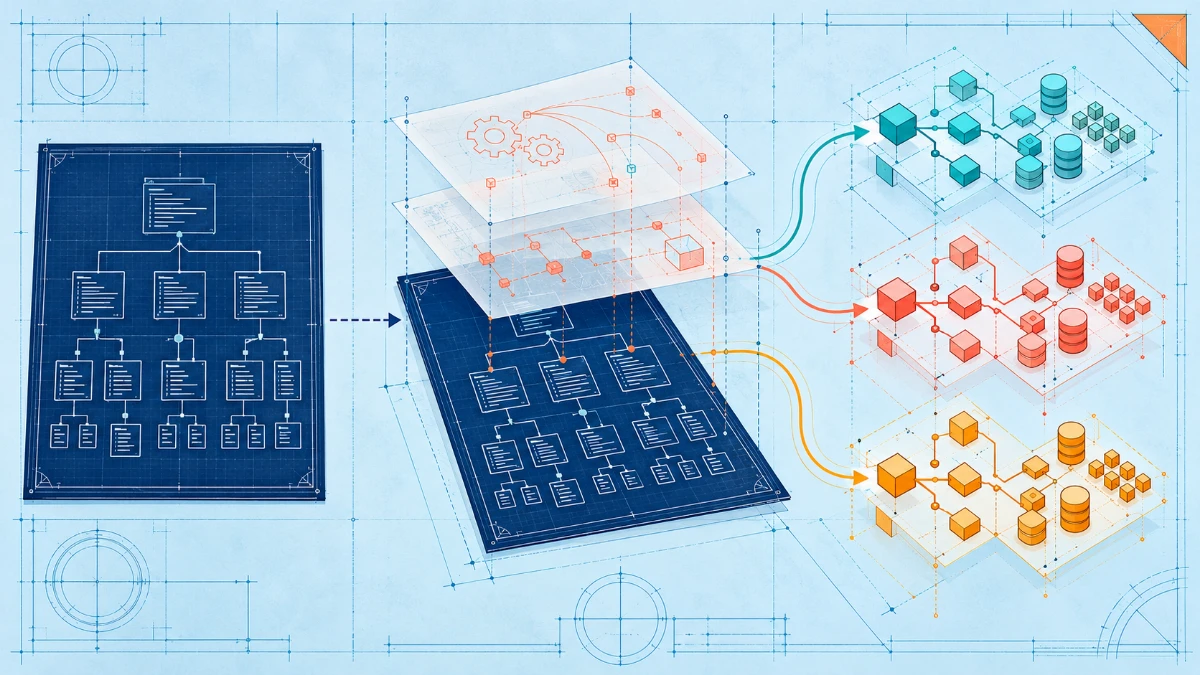
PostGamma starts with an unmodified PostgreSQL checkout. It reads that source and creates a separate tree with the changes needed for threads.
The upstream checkout stays untouched. PostGamma's rules and build tools change only the generated copy. The runtime library supports the threaded code.
This approach produces a threaded PostgreSQL server. It also lets me build an embedded library for C and Python applications.
Why I stopped editing PostgreSQL directly
My first prototype used direct edits to PostgreSQL. With AI coding tools, I had a version that compiled and passed regression tests after about 48 hours.
That was a useful start. But I would have to keep those edits working as PostgreSQL changed. The prototype did not solve that maintenance problem.
So I changed the approach. I moved the work into a source transformation and a runtime library. PostgreSQL's source became an input to the build.
Keep the input and output separate
The build has a simple shape:
Upstream PostgreSQL checkout
        (kept unchanged)
               |
               v
    Clang + PostGamma rules
               |
               v
      Generated source tree
               |
       + PostGamma runtime
               |
               v
Threaded server or embedded library
First, the build checks that the checkout is at the expected upstream commit and has no local changes. The source-copy step then exports that commit into the build directory.
The transformation changes this copy. For example, accesses to backend state can become calls into PostGamma's runtime.
For the threaded server build, that tree is in
build/generated/postgres/. I can open the generated C files, compare
them with upstream, and debug the result.
When I need to fix a transformation, I change its rules or build tools. The next build generates the source again. I don't maintain edits inside the generated directory.
This is what I mean by keeping the upstream source untouched. The output is a modified PostgreSQL build, with PostGamma's runtime linked into it.
Why use Clang
Clang parses the C code. It can find a variable's declaration and the places that refer to it. This matters when different variables share the same name.
PostGamma uses that information to prepare source replacements. The rules say which state needs a new owner and which operations need runtime support.
Clang does not decide the ownership model for me. I still have to write and review those rules.
One example is the session time zone
A PostgreSQL backend normally has its own process. Many writable global variables are private to that process. Threads share an address space, so those values need explicit owners.
Take session_timezone. One connection can use UTC. Another can use
Asia/Shanghai. Changing one connection's setting must leave the other
connection's setting alone.
The ownership rules mark this variable as session state. The transformation redirects its accesses to the active session's storage. The runtime binds a worker thread to that state before it runs PostgreSQL code.
This lets me describe the ownership rule and generate the affected accesses. I don't have to edit each use by hand.
Other values belong to a database instance or a PostgreSQL execution role, such as a backend or checkpointer. Here, a role means a runtime task, not a SQL user role. Some values can stay shared because they are read-only. Those choices also live in the ownership rules.
Check each generated change
The transformation produces a replacement plan: a list of exact text edits for each file. Before applying it, the build checks each file's source hash. It also checks the original text at each replacement location. A mismatch stops the build.
These checks are in the replacement tool. They help catch a plan being applied to source it was not built for. The tool also rejects replacements that overlap or fall outside a file.
The generated code is available for review. I can compare the original source, the planned replacements, and the resulting C code when something goes wrong.
What the runtime still has to do
Generating the source is one part of making threads work. The runtime still has to initialize state, route cancellation, manage waits, and clean up a connection when it closes.
A new thread also needs explicit initialization rules. It does not get a
private copy of its parent's memory through fork().
PostGamma keeps PostgreSQL's SQL parser, planner, executor, transactions, WAL, and recovery code. The transformation changes how that code finds state and works with the runtime.
Threads also share failures. In an embedded application, a native memory fault can affect the host process. Keeping the upstream checkout clean helps with maintenance; runtime behavior still needs careful testing.
Following upstream changes
An upstream update can change assumptions in the rules. It may need new rules or runtime work. I still need to generate the new tree and test it.
A
weekly compatibility workflow
tests PostgreSQL's REL_19_STABLE and master branches. The
current product target is PostgreSQL 19. Testing a development branch
helps find adaptation work early.
I also use PostgreSQL regression and isolation tests, runtime tests, and C and Python package checks. They cover behavior that source checks alone cannot prove.
This is the approach I want to keep: start from upstream PostgreSQL, generate the changes, and test the result. The upstream code stays easy to compare with the threaded build. The rules and runtime are the parts I maintain in PostGamma.